Wednesday, May 18, 2011

What's the Salado Term for "Fat & Out of Shape"? - Tonto Nat'l Monument 5/16/11

Tonto National Monument's surrounding beauty, dominated by Mesquite tree and Saguaro cactus, masks an insidious cruelty. There, sitting high above the basin, daring the curious to leave the comfort of an air conditioned car or visitor center, sits the Lower Cliff Dwelling. Sure, it's observable from down below, but who could come all that way and simply stare from afar? One must inspect its wares up close and personal. A one-mile hike round-trip? Paved but steep, clocking in at an intimidating 350-foot ascent? Have to. Will. Damn this to hell. My gait, so confident and assured at first, quickly slowed to a crawl, and the only available sound to drown out the bees was the jackhammering of my poor, untested heart. I gasped loudly and often, and the sweat, that glorious reminder than one is pushing it too far, moved from trickle to monsoon, and at the halfway point, I half expected my knees to buckle, sending my heap over the edge to be scraped from the parking lot like so much chewing gum.
But I get ahead of myself. First, we had to get there. We left Scottsdale, AZ early in the morning, assuming the map's measure of closeness would get us to the monument in no time flat. Do not be fooled. If you decide to take AZ-88 (Apache Trail) - as one logically would, given that it's the shortest distance between two points - be prepared for hell. Or, if you're familiar with the film Wages of Fear, a white-knuckled delivery of explosives over terrain better reserved for the pre-automobile age. For twenty-two insane, regrettable, curse-laden miles, we ambled along the high and the low, the rough and the rougher, and, most importantly, the barrier-free, with only a tuft of weeds separating our car from oblivion. Early in our drive - the part that was paved - we saw a car overturned, its driver on the side, waiting for the emergency vehicles to arrive. My god, we should have asked ourselves, if the easy part of this road took no prisoners, what could we expect once it got worse? Once ahead of schedule, the pass chewed up our time and spit it overboard, and I'll be damned if the surrounding cacti didn't cackle with delight at our arrogance. Oh, you're going to Tonto?, a particularly nasty Saguaro asked us on an especially brutal hairpin, I hope that isn't a bit of squealing coming from your brakes, foolish one.
Our brakes did squeal, and we wondered if we could possibly see tomorrow, let alone the remaining monuments for the day. As I am writing this blog entry, we did in fact survive Apache Junction, though not without a great deal of stress. Is this how normal people take a vacation? As with so much, only the obsessive-compulsive end up clinging to life on a poorly maintained mountain road. That said, Tonto stands as one of our finest achievements, and the passport stamp will always remind us of what we went through to secure its glorious green ink.  But is it worth it, this Salado dwelling from 700 years ago? Had this blast from the past merely been tucked between the VC and a Porta-Potty, the answer would be a resounding NO. Indian ruins we've seen, and after awhile, they all start to look alike. People were here, they left some pottery, then disappeared without explanation. Tonto, on the other hand, is transformed from the typical to the transcendent by its gorgeous perch overlooking Roosevelt Lake. As such, it's a keeper, and impossible not to love.
It's a tough love, and one that might require CPR, but when one reaches the top, pride rushes forth like the blood to your face. As I arrived, broken but not beaten, I observed a lonely park ranger, wisely hogging the shade on this punishing May day. Our chat was brief but pleasant, though I was a bit confused by her confession that she had worked here for sixteen years despite having no particular affection for prehistoric peoples of the Southwest. She did confess a certain attachment to the mystery of Tonto, which holds for every other site related to excavated ruins. We know so little about these people, and despite a treasure trove of items from within their walls (the theft of which prompted the Antiquties Act of 1906), we speculate more than we proclaim. I for one prefer to gaze upon the surroundings without a great deal of knowledge. At the very least, we know that the Salado were smart enough to build their abodes on high, both to appreciate the beauty of what lay before them, as well as keep an eye out for danger.
In case you're interested, there is an Upper Cliff Dwelling, but tours are only available from November through April, largely because the hike is so damned long that the summer heat would likely kill every single person who gave it a shot. Even the ranger, honest to a fault, admitted that the Upper Dwelling hike wasn't really worth it, but then again, should I trust the person fanning herself while sitting on a cool ledge? I half doubted she'd ever been out there at all. No matter, as I wouldn't go unless airlifted by helicopter. The visitor center, though safe and sound and out of the sun, is pretty sparse and typically embarrassing, showcasing dated items that may have been inspected by Theodore Roosevelt himself. The film went unwatched, though I can't imagine it could compete with the drama of the day. Tonto National Monument has been survived, and yes, I'm the better for it.


FINAL RATING

8/10

Sunday, April 24, 2011

Yellowstone Nat'l Park, Part II: Midway Geyser Basin 9/4/10

65 degrees......A perfect day for a perfect place.

Following our morning at the Upper Geyser Basin, we realized that we had seen approximately 1/8 of the park. Yellowstone is big.......really big. We had heard of vacationers spending up to 9 days at the park and were a bit nervous knowing we had a mere day and a half in this place of wonders.

However - have no fear....the Cales are professionals in the car. Give us 30 minutes at the Grand Canyon and we will have covered most of the sights. 60 minutes?? Half of Arizona......Okay - exaggerations be damned, but we have mastered the task of maximizing every visit we have ever taken. Most people scoff at the idea of moving so fast, but we have a physical need to keep going....We are not the types of people to relish time by the pool at hotels, spend half a day at the spa, or stop for a peaceful sojourn through the forest trails relishing the sun on our faces. We have places to go and stamps to get. Our biggest nightmare on the road??? Getting to our nightly destination before 5pm. Really....We fret and say, "What on earth are we going to do? I know we just spent hours driving 400 miles, but the whole NIGHT is still open. Is there a NPS site somewhere near?"

Oddly enough though, we don't do drive-bys. Our first trip to Antietam National Battlefield lasted approximately 15 minutes and consisted of the Visitor Center and the field outside it. We vowed to never not do justice to a site again. We returned one year later, and spent hours with a guide book, pouring over every single site in the park. We may move fast, but we make them count. It just works for us.......

Following the beautiful morning at the Upper Geyser Basin, we stopped for lunch at the Old Faithful Inn. The inn of high wooden beams, elk antlers, and throngs of tourists, is also one of the only places to eat in the entirety of this park. Given that Yellowstone covers the approximate size of Delaware, this seems odd, so one must take the advantages of any restaurant within 50 miles. Packed with camera-laden visitors, the inn was also home to a very large hall restaurant that served, surprisingly, very good food. The windows were open and a September breeze blew through the hall as we watched the animal on the plain that oddly enough was also our plates....Sorry Mr. Bison, but in the words of Austin Powers' Fat Bastard, "GET IN MAH BELLY!!!"
Brooke had the equivalent of toilet paper with band-aids wrapped around her hobbling foot. They don't make Ace Bandages like they used to, but although her foot would barely fit in her shoe because of the swelling, we pressed on.

Just north of the Upper Geyser Basin and Old Faithful lies a small valley with the largest geyser pool in the park. Midway Geyser Basin peeked out on the hill as we turned the corner. We joined hundreds of other travelers to walk up the planked trail to the top of the glorious Excelsior Geyser.

The blue......how to describe the blue of the pool??? Even though the heat clouds pour off of the crater, the crowd gets brief glimpses of a color that is just not supposed to exist, other than in a Crayola box.

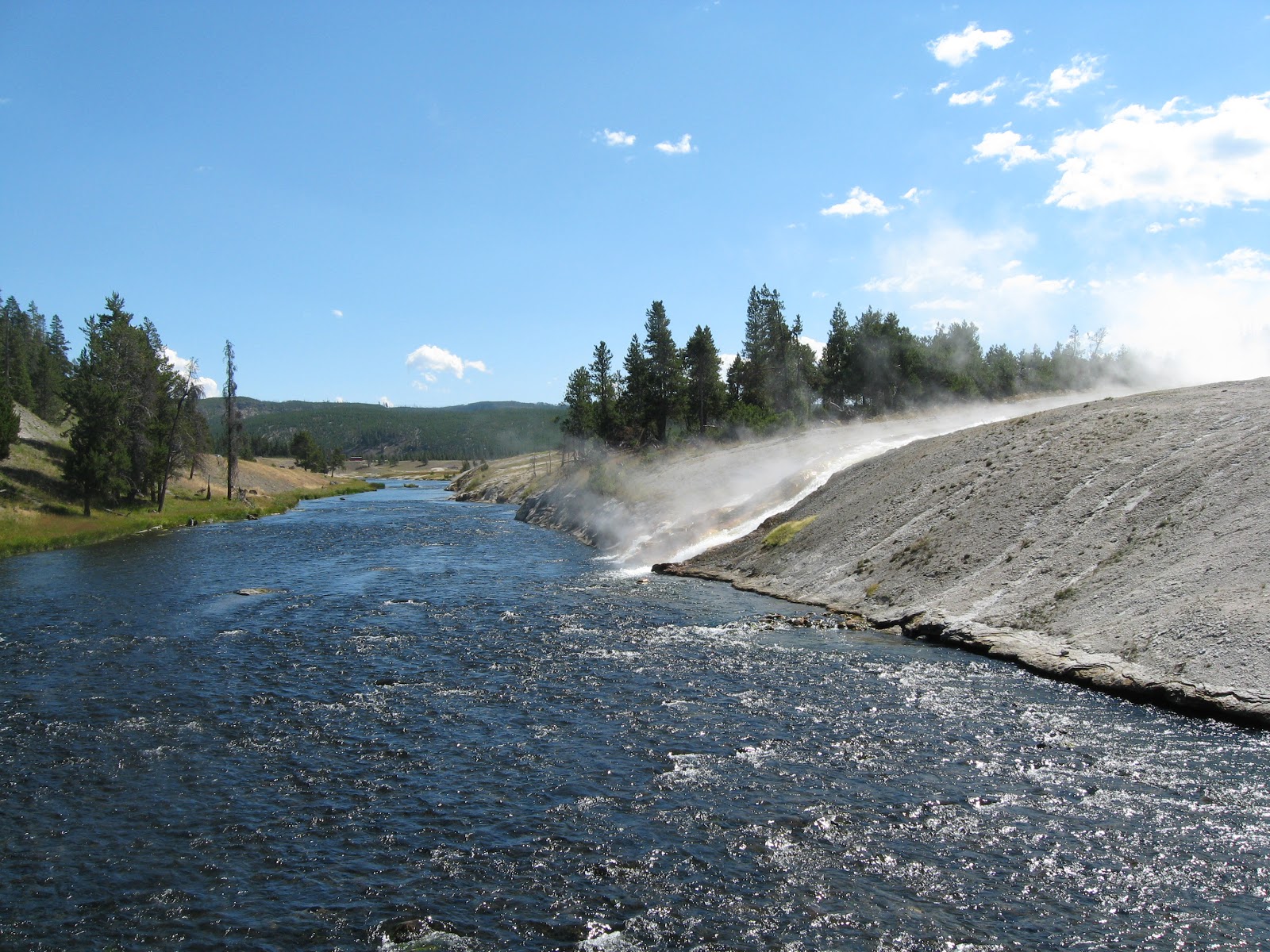
Excelsior Geyser is h-u-g-e. 4,000 gallons of overflow water pour into the Firehole River every minute. Old Faithful would need two months to produce the water that Excelsior spills over in one day. The steaming geyser water hits the river below with an audible hiss. People standing on the walkway to watch were so enthralled with the view that not one, but two hats flew off the heads of their owners straight into the river.
The wind was blowing at a fierce velocity, despite the blue skies. However, it was most welcome when on the plankway, as the heat at the Midway Geyser Basin reaches oppressive levels. Nowhere in the park do you feel the supervolcano's heat more than in this spot. The sulfur smells are also especially strong here. (The West Thumb Geyser Basin by Yellowstone Lake is oddly devoid of the sulfur odor, even though the landscape is dotted with numerous geysers). This place, though, was Rotten Egg City.

No matter though....a few moments of heat compared to the fires of a crematorium can still not erase the wonders of the park. Grand Prismatic Spring, the largest hot spring in the park, can only be viewed at a distance. We watched dozens of people stop for a second or two before being forced to move due to the rising temperature. Viewed only from a distance, the colors of yellow, orange, and green contrasted greatly to the blue of Excelsior Geyser.

The Midway Geyser Basin Walk is a short one......You can easily traverse the entire pathway in 15-20 minutes. It is highly congested and snapping pictures can be difficult without getting bumped, or having an errant hand cross your viewpoint, so for the best shots, position yourself wisely and bump back. This is not a place to lounge like the Upper Geyser Basin. The heat, odor, and large crowds make it a place to cover, but not linger. You MUST get out of the car and experience this place in its glory......If WE can, you surely can as well.....

Wednesday, April 13, 2011

Yellowstone Nat'l Park, Part I: The Upper Geyser Basin 9/4/10

The National Park journey begins and ends with Yellowstone. Others might be your first, and one will certainly be your last, but when you scan the memories of past visits, nothing will quite measure up to that vast expanse of territory in the Northwestern corner of Wyoming. Sure, Yellowstone runs the risk of being more legend than fact - more anticipation than payoff - but here's to the true giants, the parks that dwarf the pretenders through sheer beauty and unparalleled awe. A dozen visits could never hope to get it all, of course, but we were pleasantly shocked that in our day and-a-half, few stones were left unturned, at least in terms of the "obligatory" elements that make up any guide book. We didn't hit the Tower-Roosevelt section, were nowhere near the Northeast entrance, and yeah, we missed a stamp or two (why, exactly, did we drive right by the Museum of the National Park Ranger?), but as we left for home, we had no lasting regrets. The weather held up nicely, the clouds parted, and the park traffic - always rumored to challenge one's sanity - flowed with effortless determination, as the occasional stray bison proved to be more upsetting than the motor vehicles.
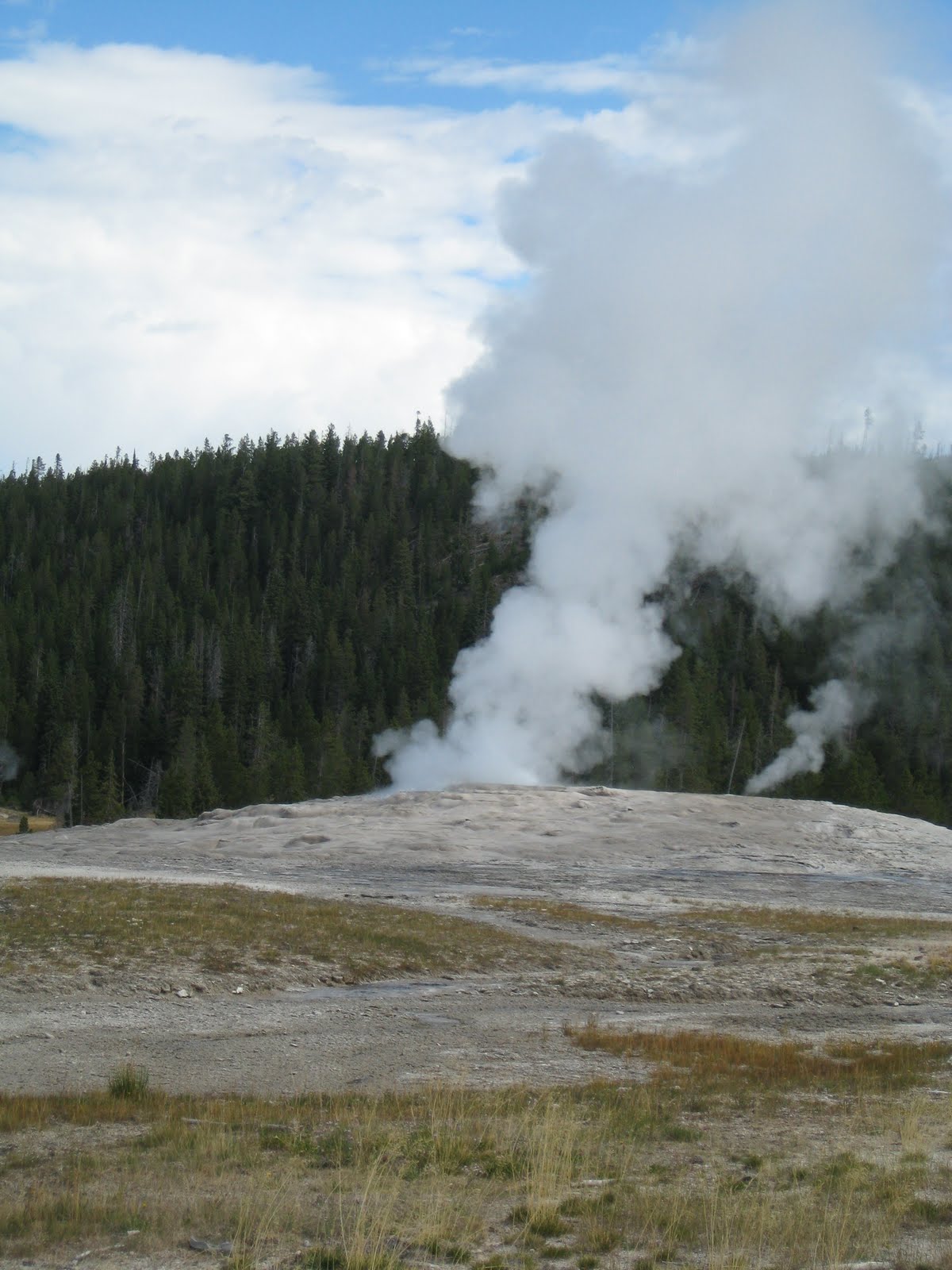
Where to begin? While our visit technically began at Grant Village, our hearts first soared at the Upper Geyser Basin, perhaps the most interesting patch of earth we're likely to see in a lifetime. If you'll excuse the cliche, this place is like nowhere else on earth, and after finally getting here, we feel no guilt about saying that it's the duty of every American to make this trek before life passes you by. And while the leisurely walk must, by necessity, begin with Old Faithful, what does it say about a tour when the most famous part is arguably the least impressive? Needless to say, the ever-reliable standby is a treat (especially as the anticipation builds right before the next rush of water and steam), but the Basin has more impressive tricks up its sleeve, providing a virtual explosion of sights, sounds, and smells that make one feel as if they're on a movie set. Every ten feet one must pause and reflect that yes, one is atop a vast hydrothermal area containing 20% of the world's geysers, all of which hint at the potential destruction beneath their bubbly charm. We're standing amidst our eventual doom, but such news means little when you're dashing about like a sugar-soaked first grader.
It bears repeating that the long walk ahead of us was daunting for more than the expected reasons; after all, Brooke was still hurting from the severe ankle sprain inflicted at Grand Teton National Park. While the swelling was up and the discoloration expanded, Brooke was determined not to be wheeled around like a grandmother. As we made our way up the steps of the recently completed visitor center (it's a keeper), an audible snap instantly changed her mood. Not for the worse, mind you, but in the direction of greater joy. The snap, for whatever reason, made her gait less strained, and while still limited, she could push along at a decent pace. Instead of taking all day, this would be a jaunt, and one that would be absent the much-feared grunts and groans of the wounded. Inspired by her courage, we got our stamps at the VC and walked to Old Faithful. Again, the giddy crowds helped create a lasting scene, but we had more ahead of us than we had any right to expect.
Early on, the walking tour invites you to look upon Geyser Hill as well as several impressive Springs (Blue Star and Chinese). The distinctive odor is an immediate attention-getter, and from every corner, hot water shoots and spits from cracks in the earth. The foot bridge is a masterpiece of putting one right in the action, and despite the proximity to many of the bursts, no one ever seems to get wet. Close, but not quite. Walking further, we were surprised by what, for us, was the most active: the Sawmill Geyser. As it spewed and jetted forth, never seeming to tire, we couldn't get enough of its power, moving around to catch every possible angle. The slap and splash of hot water against rock and earth are instantly transformative, and you wonder if you'll ever be able to muster sufficient enthusiasm at future NPS sites. Of course you will, but you'd better put some time between them and this glorious natural wonder. Grand Geyser (worth waiting for, they say, but our timing was off) was next, followed by Beauty Pool and Giant Geyser. Not all of the geysers are as timely as Old Faithful, of course (some take numerous hours, even days, between spurts, while others along the way will keep you for several birthdays), but luck was often with us, as was the case with the spectacularly positioned Grotto Geyser and its uniquely shaped cone.
Reluctantly leaving Grotto behind, you pass the justly famous Riverside Geyser, right before hitting the end of the line: Morning Glory Pool. Pictures do capture some semblance of the colors on display, but until the naked eye has glanced upon the real deal, it's doubtful you've ever really considered nature's bounty. Blues, greens, and yellows have never been this potent, and like so much at the Basin, mere words fail to take stock. Just be quiet, block out the world, and stare. When so much of our lives are spent facing ugly urban squalor, graffiti, or the dirt-caked shells of modernity, it shakes us to our core that yes, we can leave it all behind for a bit and, well, look at this.
How does the brain process such imagery? Apparently, for some, Morning Glory has inspired vandalism and idiocy (over the years, countless items have been fished from the pool), but on this day, we simply smiled as content dopes often do, delighted that while we had postponed this trip for far too long, we were finally here. An icon not vanquished, but met on its home turf. It will be here long after we're gone, and for reasons unknown, such news fails to terrify. We're all due to be humbled now and again, and the Upper Geyser Basin is as good a place as any to be reduced down to our proper size.

FINAL RATING

10/10

Saturday, March 19, 2011

Stamp Sickness Part II: Anniversaries, Shrines, and those Damned Magnets

If there's a break in the clouds and a penny to spare, our thoughts head in the direction of visiting an NPS site. Even if we've been there before, or have drained it dry of tidbits and collectibles, there's always the possibility of a new stamp that some aging volunteer had assumed was junk. Why, there could be a long-lost picture stamp stuffed in a drawer somewhere that could have been brought out since our last visit! If there's a chance - even a small one - we're willing to gas up and hit the road. And then there's the new wrinkle that's destined to drain our sanity even further: the Passport Program's 25th Anniversary Stamps. Just when we thought there was no reason to look back - only forward - we are forced, through compulsion alone, to retrace our stamps and stuff our second passport book (also a 25th Anniversary edition) with these little ink devils. Why do they torture us so? Don't they know we'll suffer from the DT's until this damned deed is done?
So yes, while we were excited about hitting new sites on our most recent trip to Arizona, we also logged significant miles throwing open the doors of familiar visitor centers to hunt down the anniversary stamps. Even Capulin National Monument, an hour out of the way despite our fatigue, could not be ignored, even though we had no intention of driving up to the top once again. In, stamp, and out, all in under a minute of rushed excitement. And if we were told that they forgot to tell us about the odd little rarity that just arrived in the mail that morning, we'd be back again, even if we had nothing else to do in the area. Fortunately, our mental illness is directed at sending more dollars to an already strapped element of the federal government. No one is harmed, except of course the occasional ranger who gives us lip and doubts a stamp's existence.
And then there are the park brochures, called "unigrids" by the faithful. While containing beautiful pictures and valuable information, why not slice them down to size, frame them, and decorate the walls of our home? While we've limited their scope to two rooms and a hall, there's no reason we can't go further, spending hundreds of dollars to dazzle the eye with assorted collages and artful poses. The images are diverse and colorful, so they really add character to an otherwise bland environment, and they sure beat the presidential photos we preferred in years past. In the end, it's always better to stare at Devils Tower instead of Warren Harding.
Finally, there are the magnets. Not as vital as the stamps, of course, but pretty damn close. The obsession started harmlessly enough in December 2009 at the Salinas Pueblo Missions, and though it was not known at the time that it would feed our OCD, it took only a month for the collection to catch fire. But what to do about places we had already visited? Would we have to drive back? Not necessarily. Fortunately, there's an Arizona-based organization called Western National Parks Association, and in addition to stocking bookstores at assorted NPS sites, they have a teeming catalog of park-related collectibles, including those glorious magnets. As such, we were able to secure magnets from well over a dozen past sites that would otherwise elude us. Still, the WNPA is not everywhere, and for some, we would have to make a personal appearance. Hey, it's always a good thing to see America's treasures, but I can't say it tickled my travel bone to be forced to hit Agate Fossil Beds once again. Needless to say, we went anyway, taking a weekend to also hit Fort Laramie, Scotts Bluff, and Chimney Rock.
Will we ever stop? I doubt it, as our refrigerator still has space galore; more than enough to accomodate over 100 sites. But why? Aren't such collections usually reserved for the severly autistic or eldery shut-ins who spend more time talking to their trash than other human beings? Sure, every serial killer or mental patient has a box of something to foist on outsiders, but for now, we're still in possession of our faculties. That said, check back in a few years to see how we're doing. At the very least, we'll have more magnets to show you.

Wednesday, March 16, 2011

Side Dish: Queen Mine Tour - Bisbee, AZ 3/5/11

Our country's history, above all, is the story of capital versus labor. Not to descend into Marxist paranoia or anything, but whenever we're honest with ourselves and the legacy of the American Way, we come face to face with broken backs, dirty faces, and the cigar-chomping pigs who exploit them. From Pinkerton goons firing on women and children, to company towns that had all the good cheer and freedom of Stalinist gulags, the nation's poor have chopped, picked, smashed, and choked, all in untold pain for the benefit of a few. I think we all know this in our heart of hearts, but prefer the comforting fable that via the proverbial bootstrap, anyone can be anything, which, translated into Americanese, means we all expect to be rich inside of an hour. Most of us, however, are working people. Maybe not exploited, abused, and tossed aside like so much rubble, but paycheck to paycheck nonetheless. And yet we always keep one eye on that mansion on a hill, straightening our cheap ties in case we're ever asked to the grown up's table.
So here we are in lonesome Bisbee, Arizona - a progressive town nowadays, what with its gay pride parades and hippie ethic - once the epicenter of copper mining in the Southwestern United States. And in case you doubted the official story, it retains the epic scar of the Lavender Pit Mine to prove that while we get so much wrong, we are experts at tearing the earth to pieces for its mineral riches. The pit remains jarring, but such buried wealth built this country, and while we might feel guilty, there's no denying it. Sure, such mines destroy any and all natural beauty in a given area, and the damage lasts well beyond the lives of those who made it happen, but what else have we? Surely windmills wouldn't have powered the United States to the status of a global titan, right? So it's a conflicted legacy, and in a place like Bisbee, we take all the pain, blood, and tears, and spit it back as tourism. And why not? When in doubt, slap on the gear of a miner, sit your ass on a tram, and go where so many went, black lung and all. Only now, it's a theme park. Sixteen-hour days with no health insurance as a vacation.
So why go on the Queen Mine Tour? Because it's only $13 a person and you've never been in an actual mine before, dummy. And while it was slightly humiliating to be the only person on the tour to be handed the XXL yellow slicker, it was kind of cool to be strapped in and outfitted like we were all headed to our doom. They place the helmet on your head, squeeze you into your belt, and pat you on the back with good fellowship. It's not at all an authentic mining experience (first of all, there aren't enough kids to round out the child labor quota), but few can turn down an opportunity to enter the bowels of the earth and return unscathed. And hell, it's only 1,500 feet down, and while cool (the mine is always 47 degrees), no one would have to work up a sweat with a pick-ax. Sure, the man in sitting in front of me was so close to my lap that I damn near felt obligated to tuck a dollar bill in his g-string, but it just felt good to get out of that gift shop before I bought something predictably silly.
The tour lasted 75 minutes, which wouldn't have been half bad had the tour guide hit reliable English more frequently than one out of every ten words. He was a charmer, but he could have been cursing us under his breath and we wouldn't have been the wiser. Though the expected sentence - "mumblemumblemumble ... INSTANTDEATH ... mumblemumblemumble ... GETTHEHELLOUTNOW" - never came, the history lesson wasn't all it could have been had we been led by a firm, full-throated speaker. Oh well. He took us off the tram now and again, up some rickety stairs, and into various nooks and crannies where holes were drilled, dynamite set, and poor mules left to go blind and drop dead, all for the glory of copper. To be sure, the danger of the mine was never minimized, but I wonder how accurate the impressively low death rate actually was. Fine, maybe few died right there and then, but how to account for cancer and respiratory failure? One imagines few lived to collect Social Security.
In all, the mine tour is a must-do, as much as it's always obligatory to visit any place a town is known for. Bisbee itself, while similar to some of the nice mountain towns we've seen a million times, is not the stuff of dreams, often appearing low rent and dilapidated instead of quaint and rugged. We'd have stayed longer, but, well, none of the cafes and coffee shops looked like they would remain standing by the time we emerged from the mine tour. Our visit, like so much else on this trip, was mandatory given that we drove right by two short years ago, but we left with little more than a shrug. Yeah, come if you're in the area (because you're likely to end up in Bisbee by accident), but don't put yourself out too much. Unless you simply must snap a photo of Copper Man. Which we also did.

Saturday, March 12, 2011

Side Dish: Fort Craig Nat'l Historic Site 3/5/11

This should not be a side dish. In a perfect world - one in which the faceless cowards at Eastern National didn't make arbitrary distinctions between the NPS and BLM, thereby denying the latter their own proud set of passport stamps - we'd make the turn from Interstate 25, drive the dozen or so miles of dirt road, and pull into a well-scrubbed visitor center to receive our bounty. No such luck. Mind you, we knew there wouldn't be any stamps at this location (we have studied the appropriate lists enough to know every last hiding place), but we felt obligated to at last make a visit, largely because we'd seen the road sign so many times that curiosity finally overtook common sense. I also knew that unlike many forts in the NPS system, this non-NPS locale was barren beyond belief, and what remained standing was barely enough to suggest a fort had even existed. Oh well.....what's an extra hour or so as the New Mexico sun begins its final fade?
It's a shame Fort Craig doesn't receive more attention, however, because from a historical standpoint, it can stand with other, more well-known structures. According to the brochure, "By July of 1861, Fort Craig had become the largest fort in the Southwest with over 2,000 soldiers and growing." It played a key role in the region's Civil War skirmishes (a show of force at the fort intimidated Confederate troops into squelching plans for a direct assault) and during the Indian Wars, numerous Buffalo Soldiers made their home there. During the fort's existence from 1854 until 1885, life was often described as lonely and deadly (leaky roofs, crumbling walls, and crowded conditions defined the remote site), but as conflicted as its legacy can be for modern historians, its continued preservation ensures that we'll always debate the merits of policies that both created an empire for some, while destroying a way of life for others.
Given the late hour, we were the only visitors at the site, though it's not hard to imagine the same would be true had we stopped by hours before. Some folks just dig forts - and we count ourselves among them - but as time goes by, we find that we're less inclined to drive to such places that fail to result in the inking of a stamp pad. The visitor center at Fort Craig not only lacks the sacred ink, but much interpretative data at all. I clearly surprised the skeleton crew on hand, as an aging woman ran inside to greet me, just in time to hand me a brochure that was clearly visible from the room's lone rack. I later learned that this woman lived on site in the RV parked next door, along with her husband, and that, along with a salary that can't be much more than the couple's Social Security checks, they were provided food, propane, and cyanide capsules for the winter months. These caretakers are charged with protecting the fort's shell from vandalism, though I can't imagine who would drive all the way out here to piss on some bricks. Never underestimate the will of your average bored teenager, I guess.
The site does feature living history displays and celebrations, but on this day, there's little more than a brisk walk along a rocky path, which inexplicably fails to loop around, forcing visitors to cover the same ground on the way back. This might sound trivial, but for the usually lazy and car-bound, this can be critical. The ghostly fort is spare, stark, and sad - and perhaps a little difficult to contextualize - but with the onset of twilight, the decaying walls held a certain grandeur, as if the past had a little more to say before it faded into silence. But as we drove away, leaving behind a lot of unanswered questions (the VC cries out for a film), I couldn't help but think about that old couple, likely finishing their Parcheesi marathon before settling in for a long, silent evening beneath the stars. What brought them here? Will they ever leave? And when will they once again meet with crazily obsessed visitors intent on seeing everything in the Land of Enchantment? Here's to 'em.